Theory and History of Ontology (ontology.co)by Raul Corazzon | e-mail: rc@ontology.co
Bibliography of the Ontologists from 16th to 18th Centuries (First part)
Contents of this Section
The Rise of Ontology in the Modern Era
This part of the section History of Ontology includes the following pages:
Birth of a New Science
The History of Ontology from Suárez to Kant
Selected bibliography on the History of Continental Ontology from Suárez to Kant
Jacob Lorhard (1561-1609): The Creator of the Term "Ontologia"
Bibliography of the Ontologists from 16th to 18th Centuries:
I. From Fonseca to Poinsot (1560 - 1644) (Current page)
II. From Scheibler to Lambert (1645 - 1777)
Francisco Suárez on Metaphysics as the Science of Real Beings
Selected bibliography on Suárez' Metaphysics
Editions and translations of the Metaphysical Works of Francisco Suárez
Index of the Pages on Modern Philosophy
Philosophers in chronological order:
- Pedro da Fonseca (1528-1599)
- Benet Perera (Benedictus Pererius) (1535-1610)
- Diego de Zúñiga (1536-1597)
- Rudolf Göckel (Goclenius) (1547-1628)
- Francisco Suárez (1548-1617)
- Gabriel Vasquez (Vazquez) (1549-1604)
- Diego Mas (Didacus Masius) (1553-1608)
- Cristóbal de los Cobos (1553-1613?)
- Jacob Lorhard (1561-1609)
- Clemens Timpler (1563/4-1624)
- Cornelius Martini (1568-1621)
- Bartholomäus Keckermann (1572-1609)
- Francisco de Araujo (1580-1664)
- Johann Heinrich Alsted (1588-1638)
- Joannes a sancto Thoma (John Poinsot) (1589-1644)
Suggested readings: among the most important studies on this period, I suggest: Courtine (1990) (fundamental) and (2005), Freedman (1999), Honnefelder (1990) and (2002), Leinsle (1985), Lohr (1988, the best introduction in English), Marion (1975), (1981) and (1988), Schmutz (2000), Wundt (1939 and (1945), Zimmermann (1998).
For the complete references see: Selected bibliography on the History of Continental Ontology from Suárez to Kant
Pedro da Fonseca (1528-1599)
Being (not God) is the subject of Metaphysics - Exclusion of accidental beings and beings of reason from Metaphysics
"Comprising four quarto volumes, Fonseca's In libros Metaphysicorum Aristotelis Stagiritae(Commentary on the Books of Aristotle's Metaphysics) contains a critical Greek text which he himself established from the best available manuscripts and printed editions. (...)
After rejectirig opinions which bold that the subject of metaphysics is God, Aristotelian 'separate substances', or being in the categories, Fonseca says that the first and adeguate subject of metaphysics is being -- in so far as it is common to God and creatures (In libros Metaphysicorum IV c.1 q.1 s.3). Understood in this way, being is analogous, although as said of species within one genus or of individuals within one species it is univocal. Between God and creatures, between created substance and accidents, between different classes of accident, and between real being and being of reason, being is analogous by analogies both of proportion and of attribution. As God is related to his being, so in proportion a created substance is related to its being. Likewise, as created substance and its being are related, so in proportion is an accident related to its being. Again, as one kind of accident is disposed to its existence so is each other kind of accident to its existence. And as real beings are disposed to their being, so beings of reason are to theirs (Metaphysicorum IV c.2 q. l s.5, 7). An analogy of attribution obtains among accidents as an analogy of two things to a third (that is, created substance), while between accidents and substance it is analogy of one to the other. The same is true of beings of reason among themselves and then in comparison with real being; for beings of reason do not depend less upon real beings than do accidents upon substance. Again, a creature is being only by attribution or reference to God. Pursuing this, Fonseca distinguishes between formal and objective concepts. A formal concept is an 'actual likeness' (actualis similitudo) of a thing that is understood, produced by the intellect in order to express that thing. An objective concept is that thing is understood in so far as it is conceived through the formai concept. Both the formal and the objective concept of being are one, but not perfectly so for the reason that they do not prescind perfectly from the concepts of the members which divide being. Being as such is transcendent as are also the concepts of thing, something, one, true and good (Metaphysicorum IV c.2 q.2 s.1, 4-5; q.5 s.2).
In God alone there is a perfect identity of essence and existence. In every creature, essence is distinct from existence, but not as one thing from another. Rather, says Fonseca, a created essence is as distinct from its existence as a thing from its ultimate intrinsic mode. In this opinion, he tells us, he is following Alexander of Hales and Duns Scotus ( 12) (Metaphysicorum, IV c.2 q.3 s.4). It is possible that here Fonseca has also to some extent anticipated the Suárezian doctrine of modes.
Excluded from the subject of metaphysics are accidental beings (entia per accidens) and beings of reason. An accidental being, in the sense excluded, is a juxtaposition of two or more beings which lack any (intrinsic) relation to one another (Metaphysicorum IV c.1 q.1 s.3). Beings of reason are those which exist only inasmuch as they are objects of understanding. Within such beings of reason, as they stand in contrast with mind-independent real beings, Fonseca distinguishes proper being of reason from one which is fictitious. Properly taken, a being of reason is one whose being depends upon the understanding in such way that it can still be said of real beings, for example, the concepts of genus, species, and the like. A fictitious being as such is a being whose essence depends upon the understanding in such way that it cannot be said of any real being, for example, a chimera, a goat-stag, or the like (Metaphysicorum IV c.7 q.6 s.5).
From: John P. Doyle - Fonseca, Pedro da (1528-99) - in: Edward Craig (ed.) Routledge Encyclopedia of Philosophy - New York, Routledge, 1998 Vol. III, p. 689.
Texts
-
Fonseca, Pedro da. 1564. Institutionum Dialecticarum. Lisbon.
Reprint: Instituições dialécticas. Institutionum dialecticarum libri octo, Introdução, estabelecimento do texto, tradução e notas por Joaquim Ferreira Gomes, Coimbra: Universidade de Coimbra, Instituto de Estudos Filosóficos, 1964 (2 voll.).
-
———. 1577. Commentariorum in Libros Metaphysicorum Aristotelis. Rome.
Original edition in 4 volumes (1615-1629).
Rome, 1577; Vol. II: Rome, 1589; Vol. III: Évora, 1604; Vol. IV: Lyon, 1612; (reprint: Cologne Voll. I-III, 1615; Vol. IV 1629).
Reprint of 1615-1629 edition: Commentarii in libros metaphysicorum Aristotelis Stagiritae, Hildesheim: Georg Olms, 1964 (2 volumes).
-
———. 1591. Isagoge Philosophica. Lisbon.
Reprint: Isagoge Filosófica - Coimbra, Universidade de Coimbra, Instituto de Estudos Filosóficos, 1965.
Latin text and English translation by João Madeira in Appendix to his Ph. D. thesis: "Pedro da Fonseca's Isagoge Philosophica and the Predicables from Boethius to the Lovanienses" (2006).
Studies
-
"Pedro Da Fonseca." 1953. Revista Portuguesa de Filosofia no. 9.
-
Ashworth, Earline Jennifer. 1968. "Petrus Fonseca and Material Implication." Notre Dame Journal of Formal Logic no. 9:227-228.
"I intend to show that the sixteenth century Jesuit, Petrus Fonseca, whose Institutionurn Dialecticarum libri octo (1564) was one of the most popular textbooks of the period, was well acquainted with [material implication].
Fonseca introduces the subject in his discussion of the appropriateness of the name hypothetical' as applied to compound propositions."
-
———. 1997. "Petrus Fonseca on Objective Concepts and the Analogy of Being." In Logic and the Workings of the Mind. The Logic of Ideas and Faculty Psychology in Early Modern Philosophy, edited by A., Easton Patricia, 47-63. Atascadero: Ridgeview.
"Petrus Fonseca was a Portuguese Jesuit who lived from 1528 to 1599. He was one of those responsible for drawing up the Jesuit Ratio Studiorum which set the curriculum for Jesuit schools across Europe, and he was also responsible for initiating the production of the Coimbra commentaries on Aristotle, or Conimbricenses, which served as texts for many schools and universities in the seventeenth century. He was himself the author of two popular texts, an introduction to logic, and a commentary on Aristotle's Metaphysics. His logic text was one of two alternatives prescribed by the Ratio Studiorum of 1599, and may have been used at La Flèche; his Metaphysics commentary was used at many Jesuit schools, and may also have been used at La Flèche.
In short, Fonseca was a leading figure in the Scholastic Aristotelian tradition of the lat e sixteenth century, a tradition which lies behind many of the developienis in early modem philosophy, and which in many ways is more important than the humanist tradition represented by Petrus Ramus.
I have chosen to discuss Fonseca on objective concepts and the analogy of being both because an examination of these issues will help us to understand how logic came to be bound up with the philosophy of mind and because the history of how these issues were treated helps solve a small problem about Descartes's sources. My paper has four parts. I shall begin by giving a historical outline of treatments of analogy and their relevance to Descartes. Secondly, I shall discuss late medieval theories of signification, particularly as they appear in Fonseca, in order to show how logicians turned away from spoken language to inner, mental language. Thirdly, I shall explain how it was that analogy, as a theory of one kind of language use, was particularly bound up with the discussion of concepts. Finally, I shall look at the distinctions Fonseca made while discussing the concepts associated with analogical terms." p. 47 (notes omitted).
-
Coxito, Amândio Augusto. 2004. "O Universal Lógico Em P. Da Fonseca E No Curso Conimbricense." Revista Filosófica de Coimbra no. 13:299-324.
-
Doyle, John P. 1998. "Fonseca, Pedro Da (1528-1599)." In Routledge Encyclopedia of Philosophy, edited by Craig, Edward, 688-690. New York: Routledge.
Vol. III.
-
Felipe, Donald. 1996. "Fonseca on Topics." In Studies on the History of Logic. Proceedings of the Iii. Symposium on the History of Logic, edited by Ignacio, Angelelli and Cerezo, Maria, 43-64. Berlin:
de Gruyter.
"Fonseca's treatment of topics in the rather substantial section on topics in Institutionum dialecticarum is of interest for at least three reasons. First, although the works of Bird, Stump, and Green-Pederson have shed a great deal of light on the tradition of the topics from Boethius to the 15th century, little is known about later scholastic views on topics in the late 16th and 17th centuries. The tract on topics in Fonseca's well-circulated logic book is certainly a good place to begin an examination of this obscure area. Second, in the tract on topics in ID a heavy dependence on Boethius's works De topicis differentiis and In Cicerona topica is very evident; a legitimate prima facie concern is that Fonseca's views on topics are unoriginal and not worth the trouble of careful study. I think it can be shown, however, that Fonseca's views on topics are very different from those of Boethius. Not only does Fonseca conceive of the primary purpose of topics in a different way from Boethius, but certain features of Fonseca's treatment of topics reflect the concerns of non-scholastic approaches to logic in the 16th century, e.g. the humanist concern for usefulness and relevance of logic, the humanist and Ramist concerns for pedagogy and easy memorization. What results is a rather unusual, hybrid treatment of topics. Finally, Fonseca's views on topics happen to provide some rather interesting background to Cartesian criticism that certain rules of dialecticians hinder the natural light of reason in the discovery of truth."
-
Ferreira da Silva, Custódio Augusto. 1960. Teses Fundamentais Da Gnoseologia De Pedro Da Fonseca. Lisboa: Tipografia da União Gráfica.
-
Ferreira, Joaquim Gomes. 1966. "Pedro Da Fonseca, Sixteenth Century Portuguese Philosopher." International Philosophical Quarterly no. 6:632-644.
-
Madeira, João. 2006. Pedro Da Fonseca's Isagoge Philosophica and the Predicables from Boethius to the Lovanienses, Leuven University.
Contains in Appendix the Latin text and an English translation of Fonseca's Isagoge Philosophica.
-
———. 2006. "Bibliografia De E Sobre Pedro Da Fonseca." Revista Filosófica de Coimbra no. 15:195-208.
-
Maierù, Alfonso. 1999. "Metafisica Ed Enti Geometrici: Benito Pereyra, Pedro Fonseca, Francisco Suárez." In Sciences Et Religions De Copernic À Galilée (1540-1610), 47-62. Rome: École Francçaise de Rome.
-
Martins, António Manuel. 1982. "Fonseca E O Objeto Da Metafísica De Aristóteles." Revista Portuguesa de Filosofia no. 38:460-465.
-
———. 1991. "A Metafísica Inacabada De Pedro Da Fonseca." Revista Portuguesa de Filosofia no. 47:517-533.
"This paper starts from the fact that the fourth volume of Fonseca's "Commentariorum in Metaphysicorum Aristotelis Stagiritae libros" (CMA) contains no "quaestiones" to Met. XII. An analysis of several explicit remissions to topics and questions to be developed in the context of that Artistotelian script (Met. XII), made by Fonseca in several places in volumes I, II and III of his CMA, reveals that his project was, from the beginning, to develop in the IV volume the subjects related to the philosophical discourse about God, divine attributes, omnipotence and freedom, contingency as well as to the separate substances'. This indicates clearly that the metaphysics of Fonseca remained unfinished given the fact that the text on an important thematic cluster was not published notwithstanding the inclusion of such text in the original project of Fonseca. It is sustained that this fact should be taken in due consideration in any global interpretation of Fonseca's thought as well as in any comparison with other (finished) ontologies. Suarez is the most obvious case but not the only one."
-
———. 1994. Lógica E Ontologia Em Pedro Da Fonseca. Lisboa: Fundaçao Calouste Gulbenkian.
Indice Geral: 0. Introdução 9; 1. A obra de Fonseca 15; 2. Determinação do objecto da metafisica 61; 3. Essência e existência 191; 4. Transcendentais e categorias 235; 5 O principio de não contradição 345; 6. Conclusâo 371 Bibliografia 377-386.
English abstract: "The aim of the dissertation is to show the place of Fonseca's work in the history of ontology. Starting with a close analysis of the texts connected with the core of classical metaphysics it is argued that the Commentarii in libros metaphysicorum Aristotelis far reacher than a mere textual commentary of Aristotle's text and represent one of the rare efforts to bring out a real synthesis of the main theoretical problems and questions emerging in the context of the aristotelian project of a first philosophy. This systematic work is carried out in the second half of the sixteenth century, just before the beginning of modern philosophy. Chapter one is dedicated to a brief account of Fonseca's work in his historical context. The remaining chapters explores some of the central topics of Fonseca's ontology. Chapter two, after a brief discussion of the aristotelian project of first philosophy, follows the transformation of this project in Fonseca's text discussing in particular his analysis of the concept of being under the heading ens commune and the meaning of the thesis of analogia entis as well as the distinction between a formal and an objective concept of being. In chapter three we discuss the question of the distinction between essence and existence in order to grasp the meaning of Fonseca's thesis of a modal distinction ex natura rei. Chapter four seeks to articulate Fonseca's interpretation of the classical doctrine of the transcendentals (unum, bonum, uerum). The wish to articulate the universality and transcendentality of the concept of being has taken us to introduce the problem of the categories in this chapter and a brief historico-critical survey beginning in Aristotle and ending in Kant. Finally, chapter five discusses the meaning of the principle of non contradiction in Aristotle and in Fonseca."
-
———. 1999. "Tópica Metafísica: De Fonseca À Suárez." In Francisco Suárez (1548-1617). Tradiçao E Modernidade, edited by Cardoso, Adelino, Martins, António Manuel and Ribeiro, Dos Santos Leonel, 157-168. Lisboa: Ediçoes Colibri.
-
———. 1999. "Pedro Da Fonseca E a Recepção Da Metafísica De Aristóteles Na Segunda Metade Do Séc. Xvi." Philosophica: Revista do Departamento de Filosofia da Faculdade de Letras de Lisboa no. 14:165-178.
"It is claimed that in order to a better understanding of the reception of the text of the Metaphysics of Aristotle in the second half of the sixteenth century one must carefully distinguish the commentaries to the whole work from texts that treat particular questions. Although much work is still to be done, the great commentary of Pedro da Fonseca appears as the major original commentary to the Metaphysics produced during that period."
-
Romeo, Luigi. 1979. "Pedro Da Fonseca in Renaissance Semiotics: A Segmental History of Footnotes." Ars Semeiotica.An International Journal of Semiotics no. 2:187-204.
-
Slattery, Michael. 1957. "Two Notes on Fonseca." Modern Schoolman no. 34:193-202.
-
———. 1957. "Fonseca on Logical Univocity." Modern Schoolman no. 34:193-202.
Benet Perera (Benedictus Pererius) (1535-1610)
"The problem that continues to haunt the commentators [of Aristotle] is how to reconcile philosophia prima as universal scientia de ente with philosophia prima as theologia. The latter appears to be a special science rather than a universal one, since it studies one particular being (albeit the highest one), whereas the former studies being qua being. Aristotle had already recognised this problem and had come up with a solution that proved so cryptic that it provoked even more discussion. (26)
In the sixteenth and seventeenth centuries this discussion received an entirely new impulse in Protestant metaphysics. Although the early reformers had a very low opinion of Aristotelian metaphysics, by the end of the sixteenth century their successors had taken to writing textbooks on Aristotle's Metaphysics which copied the model of earlier commentaries. In fact, the Protestant scholasticism that emerged from the middle of the sixteenth century onwards drew heavily on the great Commentaries of the Counter Reformation, notably the ones composed by the Spanish Jesuits.(27) Faced with the institutional problem of how to teach theology and philosophy, the Protestant masters turned back to systematic Aristotelian philosophy of the familiar kind.(28) Moreover theological contorversies within Lutheranism and between Lutheranism and Calvinism "made precise definitions of terms like 'substance' and 'accident, 'nature' and 'person' absolutely imperative. (29)
This fuelled a keen interest in Aristotelian metaphysics. The Protestants were trying to construct a metaphysics conceived as a universal science of being, a scientia de ente. This meant the removal of all the heterogeneous elements of Aristotelian metaphysics that could only with difficulty be combined with this "pure" science of being. Hence we find in most Protestant metaphysicsa marked tendency to separate natural theology from metaphysics as a science of being qua being. Therefore, by separating true metaphysics as a universal science of being from natural theology as a scientia particularis, the ubiquitous problem of the subject matter of metaphysics was solved. The first to make this separation in the sixteenth century was actually a Jesuit, Benito Pereira (c 1535-1610). (30) His solution was taken up in various ways by Protestant scholastics, both Calvinist and Lutheran, such as Nicolaus Taurellus (1547-1606), Abraham Calov (1612-1686) and Rudolphus Goclenius the Elder (1547-1628). This tradition was not an isolated German phenomenon but also spread to England. By distinguishing between "first" or "summary philosophy" and natural theology, Francis Bacon clearly draws on this tradition as well."
From: Cees Leijenhorst - The mechanisation of Aristotelianism. The late Aristotelian setting of Thomas Hobbes' natural philosophy - Leiden, Brill, 2002 pp. 23-24.
(26) Aristotle, Met. VI (E), 1, 1026a29-32. For an interesting recent account of this problem see Michael Frede, The Unity of general and special metaphysics: Aristotle's conception of metaphysics, in: M. Frede, Essays in ancient philosophy, (Oxford, 1987), pp. 81-95. For a comprehensive overview of older postions, see Joseph Owens, The Doctrine of Being in Aristotelian "metaphysics". A study in the Greek background of Mediaeval thought, (Toronto 1951, Third revised edition Toronto, 1978) pp. 1-68.
(27) See Lewalter, Spanisch-jesuitische Metaphysik und deutsch-luterische Metaphysik des 17. Jahrunderts (Hamburg, 1935; Reprint Darmstadt, 1967).
(28) On Melanchthon's use of Aristotle, see Sachiko Kusukawa, The Transformation of Natural Philosophy. The case of Philip Melanchthon, (Cambridge, 1995)
(29) Charles Lohr, "Metaphysics," (1988) p. 620. See also Walther Sparn, Wiederkher der Metaphysik: die ontologische Frage in der lutherischen Theologie des frühen 17. Jahrunderts (Stuttgart, 1976) and Donnelly, "Calvinist Thomism,"Viator, 7 (1976, pp-441-455), p. 442.
(30) On the sixteenth and seventeenth century debate conceming the relation between universal scientia de ente and particular theology, see Rompe, Die Trennung; and Leinsle, Das Ding und die Methode. For medieval "separatist" arguments, see Zimmermann, Ontologie oder Metaphysik, pp. 292-314; and Lohr, "Metaphysics," pp. 587-590.
Texts
-
Perera, Benet. 1576. De Communibus Omnium Rerum Naturalium Principiis Et Affectionibus Libri Quindecim. Romae.
-
Commentary on Aristotle's Physics; reprinted Paris, 1579; Lyon, 1585; Cologne, 1595.
Studies
-
"Benet Perera (Pererius, 1535-1610). A Renaissance Jesuit at the Crossroads of Modernity." 2014. Quaestio. Yearbook of the History of Metaphyisics no. 14:3-327.
Table of Contents: Paul Gilbert: La preparazione della Ratio studiorum e l’insegnamento di filosofia di Benet Perera 3; Christoph Sander: The War of the Roses. The Debate between Diego de Ledesma and Benet Perera about the Philosophy Course at the Jesuit College in Rome 31; Ulrich G. Leinsle: Der Widerstand gegen Perera und seine Physik in der oberdeutschen Jesuitenprovinz 51; Marco Lamanna: Mathematics, Abstraction and Ontology: Benet Perera and the Impossibility of a Neutral Science of Reality 69; Mário S. de Carvalho: Between Rome and Coimbra: A Preliminary Survey of two Early Jesuit Psychologies (Benet Perera and the Coimbra Course) 91; Francesco Marrone: Conoscenza e realtà. Benet Perera e la quaestio de primo cognito 111; Giovanni Ventimiglia: Magna est disceptatio tam inter Philosophos quam inter Theologos. Pererius e la questione della distinzione reale fra essenza ed esistenza 167; Costantino Esposito: La durata dell'essere. Benet Perera sul tempo 195; Paul Richard Blum: Platonic References in Pererius’s Comments on the Bible 215; Annalisa Cappiello, Marco Lamanna: Il principio dell’unicità del vero dalla bolla Apostolici regiminis (1513) alla Rivoluzione scientifica 229; Paolo Ponzio: Perera, Bellarmino, Galileo e il "concordismo" tra Sacre Scritture e ricerca scientifica 257-269.
-
Blackwell, Constance. 2003. "The Vocabulary for Natural Philosophy. The "De Primo Cognito" Question - a Preliminary Exploration: Zimara, Toletus, Pererius and Zabarella." In Lexiques Et Glossaires Philosophiques De La Renaissance, edited by Hamesse, Jacqueline and Marta, Fattori, 287-308. Louvain-la-neuve: Fédération Internationale des Instituts d'Etudes Médiévales.
-
———. 2004. "Thomas Aquinas against the Scotists and Platonists. The Definition of Ens: Cajetano, Zimara, Pererio 1495-1576." Verbum.Analecta Neolatina no. 6:179-188.
"Thomas Aquinas is usually studied as a metaphysician, this is not the reading given to him by three Renaissance philosophers. At the turn of the sixteenth century there were at least two schools of Thomists, one influenced by Avicenna and Scotus, and the other influenced by Averroes, a reading of Aristotle and Thomas Aquinas himself. The discussion below traces how the interpretation of Thomas' De ente et essentia was changed from being a text for metaphysics to one used for physics. One of the meanings of ens-being-was as a term that was coterminous with the object. As a result, the debate over the first thing thought or the De primo cognito debate centered around the meaning for the term ens, the following essay demonstrates how it moved from metaphysics to physics."
-
Blum, Paul Richard. 2006. "Benedictus Pererius: Renaissance Culture at the Origins of Jesuit Science." Science & Education no. 15:279-304.
Rerinted in R. P. Blum, Studies on Early Modern Aristotelianism, Leiden: Brill, 2012, pp. 139-182.
"Benedictus Pererius (1535-1610) published in 1576 his most successful book De principiis, after he had taught philosophy at the Roman College of the Jesuits. It will be shown that parts of this book are actually based on his lectures. But the printed version was intended as a contribution to the debate within his Order on how science should be conceived. Pererius redefined the meaning of scientific speculation to the effect that metaphysics was split into ontology and natural theology, and that further speculative sciences, such as physics, gained their own competence. Throughout this book, as well as in his warning against magic and in his commentaries on the Bible, the Jesuit addresses Renaissance strains of neo-Platonism, Aristotelianism, and syncretism."
-
De Pace, Anna. 1993. Le Matematiche E Il Mondo. Ricerche Su Un Dibattito in Italia Nella Seconda Metà Del Cinquecento. Milano: Franco Angeli.
Capitolo VII. Benedetto Pereira erede e critico di Piccolomini, pp. 75-120.
-
Giacobbe, Giulio Cesare. 1977. "Un Gesuita Progressista Nella 'Quaestio De Certitudine Mathematicarum' Rinascimentale: Benito Pereyra." Physis. Rivista internazionale di Storia della Scienza no. 19:51-86.
-
Giacon, Carlo. 1946. La Seconda Scolastica, Vol. Ii: Precedenze Teoriche Ai Problemi Giuridici, Toledo, Pereira, Fonseca, Molina, Suarez. Milano: Bocca.
Ristampa Torino: Nino Aragno Editore, 2004.
Capitolo II, pp. 31-66.
-
Lalla, Sebastian. 2007. "Benedictus Pererius Und Aristoteles." In Der Aristotelismus in Der Frühen Neuzeit, Kontinuität Oder Wiederaneignung?, edited by Frank, Günter and Speer, Andreas, 43-63. Wiesbaden: Harrassowitz.
-
Lamanna, Marco. 2009. "‘De Eo Enim Metaphysicus Agit Logice’. Un Confronto Tra Pererius E Goclenius." Medioevo no. 34:315-360.
-
Rompe, Elisabeth Maria. 1968. Die Trennung Von Ontologie Und Metaphysik. Der Ablösungsprozess Und Seine Motivierung Bei Benedictus Pererius Und Anderen Denkern Des 16. Und 17. Jahrhunderts. Bonn: Rheinische Friedrich-Wilhelms Universität.
Diego de Zúñiga (1536-1598)
Texts
-
Zúñiga, Diego de. 1597. Philosophiae Prima Pars, Qua Perfecte Et Eleganter Quatuor Scientiae Metaphysica, Dialectica, Rhetorica Et Physica Declarantur, Ad Clementem Octavum Pontificem Maximum. Toledo.
Partial Spanish translation: Metafísica (1597), Introducción, traducción y nota de Gerardo Bolado, Pamplona: Eunsa 2008.
Studies
-
"Diego De Zúñiga." 1999. La Ciudad de Dios no. 212.
Contents: Modesto González Velasco: Fray Diego de Zúñiga (1536-ca.1598): biografía, escritos y bibliografía: 5-57; Victor Navarro Brotons: La recepción de la obra de Copérnico en la España del siglo XVI: el caso de Diego de Zúñiga: 59-104; Gerardo Bolado Ochoa: La "Física" de Diego de Zúñiga OSA: 105-147; Lera San José: Javier, Fray Diego de Zúñiga OSA, "In Iob commentaria", 1584: 149-182.
-
Arámburu Cendoya, Ignacio. 1961. "Diego De Zúñiga, Biografía Y Nuevos Escritos (I)." Archivo Agustiniano no. 55:51-103.
-
———. 1961. "Diego De Zúñiga, Biografía Y Nuevos Escritos (Ii)." Archivo Agustiniano no. 55:329-384.
-
Bolado Ochoa, Gerardo. 1985. "Fray Diego De Zúñiga O.S.A.: Una Filosofía Como Enciclopedia De Las Ciencias Y Las Artes En El Siglo Xvi." Revista Agustiniana (Madrid) no. 26:105-150.
-
———. 1989. "La Unión De Los Estudios Filosóficos Y Retóricos En La Enciclopedia De Fray Diego De Zúñiga (1536-1599?). Aproximación a La "Retórica"." Revista Agustiniana (Madrid):557-587.
-
———. 1999. "La "Fisica" De Diego De Zúñiga, Osa." La Ciudad de Dios no. 212:105-147.
-
———. 2000. Fray Diego De Zúñiga, Osa (1536-Ca. 1598). Una Aproximaciòn Biogràfica. Madrid: Revista Agustiniana.
-
———. 2003. "Presentación De La "Dialéctica" De Diego De Zúñiga (1536 Ca.-1598)." Revista Agustiniana (Madrid):465-500.
-
Gallego Salvadores, Juan José. 1974. "La Metafísica De Diego De Zúñiga (1536-1597) Y La Reforma Tridentina De Los Estudios Eclesiásticos." Estudio Agustiniano no. 9:3-60.
-
González Velasco, Modesto. 1999. "Fray Diego De Zúñiga (1536 - C. 1598): Biografía, Escritos Y Bibliografía." La Ciudad de Dios no. 212:5-57.
Rudolf Göckel (Goclenius) (1547-1628)
"Goclenius is best described as a protestant Scholastic', his most important contribution to the metaphysics being terminological. He is the first philosopher to use the word ontologia [in Greek] (*) to describe general metaphysics (...) Strangely enough, this word does not appear in the Isagoge, but rather in the Lexicon. Still, his use of the word precedes that of Calovius by 23 years (...), and that of Jean-Baptiste Duhamel by 65 (...).
Although he does not use the term ontologia in the Isagoge, Goclenius does distinguish general metaphysics from special metaphysics in this work and a fortiori stood the concept of general metaphysics. The distinction between general and special metaphysics is not Goclenius's invention, however. The Spanish Jesuit Benito Pereira (c. 1535-1610) had already made it by 1562 (see Rompe Die Trennung von Ontologie und Metaphysik. Der Ablösungsprozess und seine Motivierung bei Benedictus Pererius und anderen Denkern des 16. und 17. Jahrhunderts1968, pp. 7-13) and an earlier manuscript making the distinction has been found (Zimmermann Ontologie oder Metaphysik. Die Diskussion über den Gegenstand der Metaphysik an 13. und 14. Jahrundert 1965, p. 60).
Both Wundt and Vollrath seem to have discovered the distinction between general and special metaphysics only in the Praefatio of Goclenius's Isogoge and have remarked that this distinction does not appear in the main text of the work. This is incorrect, however. The second part of the Isagoge is a series of disputations, the first of which, entitled De ente Communi, ad omnes Categorias conseguente discusses this distinction (Rompe is aware of this and hers is at present the most trustworthy account of Goclenius's work) Goclenius says that some divide first philosophy (prima philosophia ), which is usually called 'metaphysics', into two parts. The first is universal and studies the most general notion of being common to all things (de Ente in communi ). The second part is particular and deals with God, divine spirits (daemones ), and disembodied intellect (intellectus separatus a corpore, p. 126). Goclenius ascribes this view to Aristotle and then goes on to say that he prefers to divide things up differently. Knowledge (scientia ) should be divided into a universal and a particular part, and the universal part should be called 'first philosophy'. The particular part in turn should be divided into a 'transnatural' part which deals with God, and a 'natural' one, which deals with natural entities (pp. 126-7).
Goclenius's idea of knowledge, then, has a particular part which seems to contain every specific science. In contrast, Perera includes only theology, 'spiritology', and psychology, and Christian Wolff only theology, psychology, and cosmology, within special metaphysics. Thus Goclenius is proposing a way of cutting up the sciences such that prima philosophia is truly cast in the role of the queen of the sciences, lording over them all as the scientia universalis. On the face of it, Goclenius's taxonomy of metaphysics is more reasonable than that of Wolff or Pereira. If one is going to take seriously the notion of a 'superscience' which studies the most abstract idea of being which the objects of all specific sciences share, then one is compelled, I think, to include all of the particular sciences within specific metaphysics. This is true unless, of course, one has platonic misgivings about the possibility of being able to have knowledge about substances which have matter mixed up in them. However, a good Scholastic, wedded as he is to the spirit of Aristotle, has no such misgivings."
(*) The term ontologia was coined by Jacob Lorhard in 1606 [Note added by Raul Corazzon]
From: Goclenius, Rudolphus by Jeffrey Coombs - in: Handbook of Metaphysics and Ontology - Edited by Barry Smith Barry and Hans Burkhardt. Munich: Philosophia Verlag 1991, pp. 312-313.
"Thus the Marburg professor Rudolph Goclenius in the preface to his Isagoge in primam philosophiam (1598), spoke of two separate sciences, a universal science called 'first philosophy' and a particular science called 'metaphysics'. First philosophy deals with being, its properties and its principles; metaphysics studies the various types of immaterial being: God, the intelligences and the human soul."
From: Charles H. Lohr - Metaphysics and natural philosophy as sciences: the Catholic and the Protestant views in the sixteenth and seventeenth centuries - in: Constance Blackwell, Sachiko Kusukawa (eds.) . Philosophy in the Sixteenth and Seventeenth centuries. Conversations with Aristotle - Aldershot, Ashgate, 1999, p. 291.
Texts
-
Göckel, Rudolf. 1591. Problemata Logica. Marburg.
Reprint: Frankfurt: Minerva, 1967.
-
———. 1592. Physicae Disputationes in Septem Libros Distinctae. Frankfurt.
Partial translation in German: Rudolphus Goclenius, Disputationen zur Natur-Wissenschaft 1592, translated with introduction, notes and name index by Hans Günther Zekl, Würzburg: Königshausen & Neumann, 2007.
-
———. 1598. Isagoge in Peripaticorum Et Scholasticorum Primam Philosophiam, Quae Dici Consuevit Metaphysica. Frankfurt.
Reprint: Hildesheim, Georg Olms, 1976.
Translated in German: Rudolphus Goclenius, Isagoge. Einführung in die Metaphysik 1598, translated with introduction, notes and an essay on the author by Hans Günther Zekl, Würzburg: Königshausen & Neumann, 2005.
-
———. 1609. Conciliator Philosophicus. Cassellis.
Reprint: Hildesheim: Georg Olms, 1977.
-
———. 1613. Lexicon Philosophicum Quo Tanquam Clave Philosophiae Fores Aperiuntur. Frankfurt.
Reprint: Hildesheim: Georg Olms, 1964 (with the Lexicon philosophicum Graecum).
-
———. 1615. Lexicon Graecum Philosophicum. Marburg.
Reprint: Hildesheim: Georg Olms, 1964 (with the Lexicon philosophicum quo tanquam clave philosophiae fores aperiuntur).
-
———. 1625. Metaphysica Exemplaris. Wittenberg.
Studies
-
Lamanna, Marco. 2009. ""De Eo Enim Metaphysicus Agit Logice". Un Confronto Tra Pererius E Goclenius." Medioevo.Rivista di Storia della Filosofia Medievale no. 34:315-360.
-
———. 2013. La Nascita Dell'ontologia Nella Metafisica Di Rudolph Göckel (1547-1628). Hildesheim: Georg Olms.
"Nel dibattito seguito al cosiddetto Ontological Turn della filosofia analitica contemporanea un posto di assoluto rilievo ha avuto, e continua ad avere, l’ipotesi di distinguere l’ambito dell’ontologia da quello della metafisica. Si tratta solo dell’ultima insorgenza di un dibattito epistemologico che ha conosciuto più riprese nel corso dei secoli, in contesti anche molto differenti tra loro. A livello strettamente terminologico, la prima distinzione dell’ontologia dalla metafisica si registra all’inizio del XVII secolo, all’interno della Schulmetaphysik riformata, in particolare calvinista. È in quell’ambito che un autore come Rudolph Gōckel (lat. Goclenius) potè intestarsi una simile operazione a seguito delle istanze scaturite dall’“importazione” dei modelli metafisici dell’aristotelismo gesuita (in particolare di Benet Perera, più che di Francisco Suárez) nella Germania protestante. Erano trascorsi quasi ottant’anni dall’interdetto pronunciato da Lutero contro la metafisica e le sue pretese epistemologiche. Il “ritomo” alla metafisica tra i calvinisti coincise pertanto con la nascita dell’ontologia come scienza propriamente detta e con la distinzione di quest’ultima dalla metafisica, intesa perlopiù come teologia: nel corso delle dispute tra riformati e protestanti si affinerà un modello che dominerà il dibattito scolastico in ambito continentale sino agli anni di Kant, determinando profonde conseguenze nel modo di pensare la realtà."
-
Moreau, Pierre-François. 2002. "Wolff Et Goclenius." Archives de Philosophie no. 65:7-14.
Gabriel Vasquez (Vazquez) (1549-1604)
Texts
-
Vazquez, Gabriel. 1598. Commentariorum, Ac Disputationum in Primam Partem S. Thomae. Tomus Primus. Complectens Viginti Sex Quaestiones Priores. Alcalà.
-
———. 1598. Commentariorum in Primam-Secundae S. Thomae. Alcalà.
Two volumes: second volume printed 1605.
-
———. 1609. Commentariorum in Tertiam Partem. Alcalà.
Four volumes (1609-1615).
Studies
-
Baldini, Ugo. 2004. "Ontology and Mechanics in Jesuit Scholasticism: The Case of Gabriel Vazquez." In Scientiae Et Artes. Die Vermittlung Alten Und Neuen Wissens in Literatur, Kunst Und Musik. Vol. I, edited by Mahlmann-Bauer, Barbara, 99-142. Wiesbaden: Harrassowitz.
-
Lapierre, Michael J. 1999. The Noetical Theory of Gabriel Vasquez, Jesuit Philosopher and Theologian (1549-1604). His View of the Objective Concept. Lewiston: Edwin Mellen.
Contents: Foreword I; Preface III; Acknowledgements VII; Introduction 1; 1. Historical overview 5; 2. Life and times of Gabriel Vasquez 11; 3. Concept and external world 21; 4. Cocept and truth 35; Concept and knowledge 55; 5. Concept and Being 75; 7. Concluding observations 93; Appendix A. Chronological table of Vasquez's life 97; Appendix B. List of the writings of Gabriel Vasquez 99; Bibliography 103; Index of names and subjects 109.
-
Schmutz, Jacob. 2002. "Le Miroir De L'univers: Gabriel Vazquez Et Les Commentateurs Jésuites." In Sur La Science Divine, edited by Bardout, Jean-Christophe and Boulnois, Olivier, 382-411. Paris: Presses Universitaires de France.
-
Wells, Norman J. 1994. "John Poinsot on Created Eternal Truths Vs. Vasquez, Suárez and Descartes." American Catholic Philosophical Quarterly no. 68:425-446.
Diego Mas (Didacus Masius) (1553-1608)
Texts
-
Mas, Diego. 1587. Metaphysica Disputatio De Ente Et Eius Proprietatibus. Valencia.
Critical edition of the Latin text and Spanish translation witgh the title: Disputación metafísica sobre el ente y sus propiedades (1587) - Pamplona, EUNSA, 2003. Parte I: traducción castellana; Parte II: Original latino.
Contains a reprint of the essay: El Maestro Diego Mas y su Tratado de Metafísca. La primera metafísica sistemática by Jordán Gallego Salvadores, pp. 17-88 (originally published in: Analecta Sacra Tarraconensia 43 (1970), pp. 3-92).]: 07
Studies
-
Bastit, Michel. 2004. "De L'intérêt D'une Lecture Traditionnelle De Saint Thomas: La Question De L' esse Chez Diego Mas." Revue Thomiste no. 104:447-468.
"Résumé. On essaie ici de tester sur un texte de Diego Mas la fécondité théorique d'une lecture traditionnelle thomiste, au sens de lecture au sein d'une école. À partir des questions concernant l'ordre de l'existence à la forme et à l'essence, on aperçoit progressivement que la rigoureuse procédure scolastique utilisée par l'auteur du texte reconduit son lecteur à la question elle-même, et le met ainsi en mesure d'être philosophe en acte. En outre cette rigueur permet à une pensée de ce type d'entrer en rapport avec les développements de la philosophie exacte moderne et contemporaine où se manifeste aujourd'hui un regain d'intérêt pour la métaphysique et l'ontologie que l'on aurait tort de négliger."
-
Gallego Salvadores, Juan José. 1970. "El Maestro Diego Mas Y Su Tratado De Metafísica. La Primera Metafisica Sistematica." Analecta Sacra Tarraconensia no. 43:3-92.
Reprinted in: Diego Mas, Disputación metafísica sobre el ente y sus propiedades - Edited by Santiago Orrego and Juan Cruz Cruz - Pamplona, EUNSA, 2003, pp. 17-88.
-
———. 1973. "La Aparición De Las Primeras Metafísicas Sistemáticas En La España Del Xvi. Diego Mas (1587), Francisco Suárez Y Diego De Zúñiga (1597)." Escritos del Vedat no. 3:91-162.
-
———. 2004. "El Dominico Valenciano Diego Mas Y La Primera Metafísica Sistemática." In Francisco Suárez. "Der Ist Der Mann". Apéndice Francisco Suárez De Generatione Et Corruptione. Homenaje Al Prof. Salvador Castellote, edited by Schmutz, Jacob, 209-223. Valencia: Facultad de Teología San Vicente Ferrer.
Cristóbal de los Cobos (1553-1613?)
Texts
-
Los Cobos, Cristóbal. 1948. "In Metaphysicam Por Cristóbal De Los Cobos, S. J. Salamanca, 1582-1583 (Ms. Inédito) (*)." In Actas Del Iv Centenario Del Nacimiento De Francisco Suárez 1548-1948. Vol. I, 375-413. Madrid: Dirección General de Propaganda.
(*) De la colección de manuscritos estudiados durante los homenajes centenarios tributados al Doctor Eximio. (Edited by Eleuterio Elorduy).
Studies
Clemens Timpler (1563/4-1624)
"Within three of his writings, Timpler notes that the study and knowledge of metaphysics is required for the study and knowledge of all other philosophical disciplines. For this reason, Timpler's Metaphysics textbook merits examination here prior to consideration of his other philosophical writings. The basic components of Timpler's Metaphysics textbook can be outlined as follows:
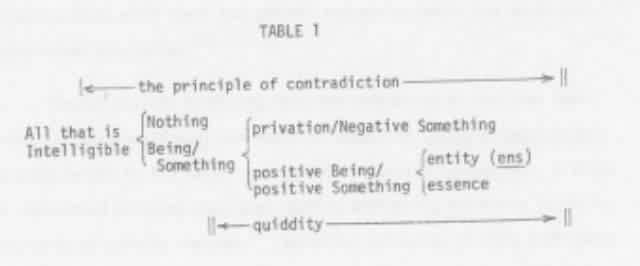
Timpler considers the subject matter of metaphysics to be everything which is intelligible to human beings; therefore, All that is Intelligible (omne intelligibile) is the all-inclusive category within which all component parts of Timpler's metaphysics are subsumed. Timpler divides the category All that is Intelligible into Something (aliquid) and Nothing (nihil). Each individual intelligible falls within one and only one of these two categories.
Timpler asserts that Nothing cannot be perfectly defined. His brief remarks concerning Nothing shall be presented within chapter 15 section 17 and within chapter 20 section 9. Timpler's "Something" (aliquid) is equivalent to "Being" (esse; est) in the broadest sense of the latter. Timpler's "Being" can be explained with the use of the following table:
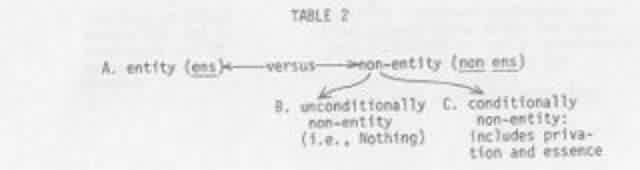
"Being" (understood in its broadest sense) includes A and C yet excludes B.
The broadest and most basic distinction made within Timpler's Metaphysics textbook, therefore, is the distinction made between something (i.e., "Being" understood in its broadest sense) and Nothing (i.e., Non-Being). There is no medium between Something and Nothing; any given intelligible object falls into one and only one of these two categories. According to Timpler, these two categories are contradictorily opposed to one another. The principle which states this contradictory opposition--i.e., which states that it is absolutely impossible for an intelligible subject matter to be both Being and Non-Being simultaneously -- is the principle of contradiction; Timpler regards this principle to be indemonstrable and absolutely necessary. The principle of contradiction is the most important rule contained within Timpler's Metaphysics textbook; in so far as it comprises All that is Intelligible, it regulates the entire subject matter of that textbook.
Timpler also notes that the principle of contradiction is "that primary complex principle which is basic to all of the arts" (i.e., to both the liberal arts and the illiberal arts).
It must be emphasized that All that is Intelligible and the Principle of Contradiction (all sub-categories of the former are regulated by means of the latter) are the broadest, most general categories not only of Timpler's Metaphysics textbook, but of all of his other writings as well. These two categories embrace the entirety of Timpler's thought as expressed within his various philosophical writings. The study of metaphysics is basic to the study of all other disciplines partly due to the fact that it directly deals with these two general categories which are basic to every other discipline."
From: Joseph S. Freedman - European Academic Philosophy in the Late Sixteenth and Early Seventeenth Centuries. The life, significance and philosophy of Clemens Timpler (1563/4-1624). Hildesheim: Georg Olms 1988, pp. 210-211 (notes omitted).
Texts
-
Timpler, Clemens. 1604. Metaphysicae Systema Methodicum. Steinfurt.
(Nine editions, including some unauthorized imprints (Steinfurt 1604, Lich 1604, Hanau 1606, Frankfurt a. M. 1607, Marburg 1607, Hanau 1608, Frankfurt a. M. 1612, Hanau 1612, Hanau 1616).
Studies
-
Freedman, Joseph S. 1988. European Academic Philosophy in the Late Sixteenth and Early Seventeenth Centuries. The Life, Significance and Philosophy of Clemens Timpler (1563/4-1624). Hildesheim: Georg Olms.
Two volumes.
Cornelius Martini (1568-1621)
Texts
-
Martini, Cornelius. 1605. Metaphysica Commentatio. Strasburg.
-
———. 1619. De Analysi Logica Tractatus. Helmstedt.
Studies
-
Pozzo, Riccardo. 1989. "Kornelius Martini: De Natura Logicae: Prolegomeni Ad Un Corso Di Lezioni Del 1599." Rivista di Storia della Filosofia no. 44:499-527.
-
———. 1998. "Res Considerata and Modus Considerandi Rem: Averroes, Aquinas, Jacopo Zabarella, and Cornelius Martini on Reduplication." Medioevo.Rivista di Storia della Filosofia Medievale no. 24:251-267.
Bartholomäus Keckermann (1572-1609)
Texts
-
Keckermann, Bartholomäus. 1600. Systema Logicae, Tribus Libris Adornatum. Hannover.
-
———. 1609. Scientiae Metaphysicae Compendium Systema. Hanau.
Studies
-
Freedman Joseph S. "The Career and Writings of Bartholomew Keckermann (D. 1609)." Proceedings, American Philosophical Society 141 (1997): 305-364.
Reprinted in: Joseph S. Freedman, Philosophy and the Arts in Central Europe, 1500-1700, Aldershot: Ashgate, 1999, Essay VII.
-
Muller Richard A. "Vera Philosophia Cum Sacra Theologia Nusquam Pugnat. Keckermann on Philosophy, Theology and the Problem of Double Truth." Sixteenth Century Journal 15 (1984): 341-365.
-
Zuylen Willem Hendrik van. Bartholomäus Keckermann. Sein Leben Und Werk. Leipzig: R. Noske, 1934.
Francisco de Araujo (1580-1664)
Texts
-
Araujo, Francisco de. 1617. Commentaria in Universam Aristotelis Metaphysicam Tomus Primus, Quinque Libros Complectens. Salamanca.
-
———. 1631. Commentaria in Universam Aristotelis Metaphysicam Tomus Secundus, Septem Libros Complectens a Sexto Usque Ad Duodecium Inclusive. Salamanca.
Studies
-
Beuchot, Mauricio Puente. 1980. "La Doctrina Tomista Clásica Del Signo: Domingo De Soto, Francisco De Araujo Y Juan De Santo Tomás." Critica no. 36:39-60.
-
———. 1987. Metafísica. La Ontología Aristotélico-Tomista De Francisco De Araújo. Ciudad de México: Instituto de Investigaciones Filosóficas UNAM.
-
Fernández-Rodríguez, José Luis. 1972. El Ente De Razón En Francisco Araújo. Pamplona: Ediciones Universidad de Navarra.
-
O'Brien, Chrysostom. 1962. "El Enigma De Francisco De Araujo." La Ciencia Tomista no. 89:221-234.
-
Wells, Norman J. 1983. "Francisco Araujo, O.P., on Eternal Truths." In Graceful Reason. Essays in Ancient and Medieval Thought Presented to Joseph Owens C.Ss.R., edited by Gerson, Lloyd P., 401-417. Toronto: Pontifical Institute of Medieval Studies.
Johann Heinrich Alsted (1588-1638)
Texts
-
Alsted, Johann Heinrich. 1613. Metaphysica Tribus Libris Tractata Per Praecepta Methodica. Herborn.
-
———. 1620. Cursus Philosophici Encyclopedia Libri Xxvi. Herborn.
Vol. I Praecognita disciplinarum; II. Philologia; III. Philosophia theoretica; IV. Philosophia practica; V. Tres superiores facultates; VI. Artes mechanicae; VII. Farragines disciplinarum.
Reprint of the 1630 edition: Encyclopaedia. Septem tomis distincta - Stuttgart, Frommann-Holzboog, 1989.
-
———. 1625. Metaphysica Exemplaris. Wittenberg.
-
———. 1999. Alsted and Leibniz: On God, the Magistrate, and the Millennium. Wiesbaden: Harrassowitz in Kommission.
Texts edited with introduction and commentary.
Studies
-
Hotson, Howard. 2000. Johann Heinrich Alsted, 1588-1638: Between Renaissance, Reformation, and Universal Reform. New York: Oxford University Press.
-
Schmidt-BigGermann, Wilhelm. 1983. Topica Universalis: Eine Modellgeschichte Humanistischer Und Barocker Wissenschaft. Hamburg: Meiner.
On Alsted see pp. 100-139.
