Digital Quadrivium Project by Raul Corazzon: four websites
Theory and History of Ontology (www.ontology.co)
by Raul Corazzon | e-mail: rc@ontology.co
Eriugena: Dialectic and Ontology in the Periphyseon
Contents of this Section
Eriugena and the Neoplatonic Metaphysics in the Early Middle Ages
This part of the section History of Ontology includes the following pages:
Eriugena: Dialectic and Ontology in the Periphyseon (Current page)
The Works of Eriugena: Editions and translations
Bibliography on the Philosophical Work of Eriugena:
The section History of the Doctrine of Categories include the following page:
Eriugena, Periphyseon Book I: Aristotelian Logic and Categories
Index of the Pages on Medieval Philosophy
The philosophical relevance of John Scottus Eriugena
"Philosophy properly speaking begin in the ninth century with John Scottus Erigena." (p. 42)
G. W. F. Hegel, Lectures on the History of Philosophy 1825-6. Volume III: Medieval and Modern Philosophy, Revised Edition, Translated and edited by George F. Brown, New York: Oxford University Press 2009.
"It is anachronistic to separate philosophy and theology in Eriugena. 'Speculation' would be a less misleading description of his thought than 'teaching'. But we must use words in any case. Although Augustine is the major source of Eriugena's doctrine, its characteristic features do not derive from the teaching of Augustine.
(...)
Platonism and Neoplatonism, that is to say the revival of Platonism especially by Plotinus in the third century A.D., were, on the other hand, freely embraced by the Eastern Fathers, by those precisely from whom Eriugena derived his distinctive thought, St Gregory Nazianzen, the brothers Saints Basil and Gregory of Nyssa and the great Origen. Here Eriugena found Christian authority for his negative theology ('one knows God best by not knowing Him'), for creation as being co-eternal with God, and for the final restoration of all things in the end. Curiously enough, as I have indicated elsewhere, Eriugena derives some Greek ideas from St Ambrose of Milan - but in fact this fits in with the new (but not, of course, on that account necessarily correct) view of St Ambrose presented by a number of our contemporaries and notably Courcelle.
The corpus of Eriugena's work is considerable commentaries, translations and original works, all making up one ponderous volume (number 122) of Migne's Patrologia Latina. The centerpiece of his achievement is the Division of Nature, written about 867, running to five books and a quarter of a million words. It deals ostensibly with the Creator, the first or primordial Causes, the created universe, and finally God as End. It considers five different and unrelated modes of being: things may be said to be according as we perceive them, according to their place in a hierarchy, according as they become actualized, according to the faculty by which they are perceived (sense or intellect for example), and fifthly according to their realization of God's image. These are truly unrelated, and illustrate the easy overlapping of what we optimistically call philosophy and theology. In the system of Eriugena the most important of these modes of being is the second, i.e. that according to a thing's place in a hierarchy.
Eriugena and his Greek predecessors, pagan and Christian, are essentially concerned with the greatest problem - or perhaps the second greatest problem - of all: assuming a Creator, how can He create? If He begins to create, He changes, is completed and has been imperfect - which imperfect - which is unacceptable. If He always has been creating, His creatures are as eternal and as infinite as Himself: they are Himself - which is pantheism. The contrast between Augustine and Eriugena is nowhere greater or more visible than in this. Augustine wrote the sixth to the tenth books of his imposing work, the City of God, on the problem of how, taking account of Neoplatonism, the creature can be united with the Creator, which is another version of the problem just mentioned. Characteristically, however practically, he looks at the matter from the point of view of man, the creature. He differs from the Neoplatonist Porphyry by accepting Christ as the great Mediator between God and man, but follows him in much consideration of mediation in general and a hierarchy of mediating demons, angels and heroes as well. It is only fair to say that he does not always take so practical a view of the problem. But how different, how more Plotinian, is Eriugena, who fixes his gaze on the Creator, scrutinizing His revelations of Himself, his 'theophanies' or 'appearances' as Eriugena calls them, for any clue; and searches the ineffable, incomprehensible and inaccessible clarity of the divine goodness for understanding, at least of what God is not. Almost the only images employed are air and light and fire, and these are used in contexts suggesting rarefaction and incandescence. The whole of the Division of Nature is essentially an exercise in trying to follow the descent, or possibility of descent, of creatures from the One, and their return to the One up the hierarchy of being. The return of all is the conversion of bodies to souls, of souls to causes (such as Goodness), and of causes to God.
One may ask if, after all, Eriugena is not a pantheist? Certainly he himself was aware that he might be thought so, but denied explicitly that he was. 'God', he says, 'is all in all. All things that are in God, even are God, are eternal.' 'We should not understand God', he writes, 'and the creatures as two things removed from one another, but as one and the same thing. For the creature subsists in God, and God is created in the creature in a wonderful and ineffable way, making himself manifest, invisible making himself visible.' But the divine nature, he finally insists, because it is above being, is different from what it create within itself.
Eriugena circles around the object of his thought insistently, patiently, lovingly. He can sustain prolonged concentration on the Creator, on that darkness, as he calls it, of incomprehensible and inaccessible light. One thinks of the nearly contemporary work of the great Irish metal-workers, sculptors and especially illuminators of manuscripts; the abstraction, the subtlety, the incredible detail. In the end Eriugena knows only that God is, not at all what He is. Of the creature he chooses to investigate for the most part only how he can be - for he refuses, under one aspect, to deny that the Creator and the creature are one thing. He cannot have truck with lower things. One might as well ask for practical considerations Teilhard de Chardin. He is sublime, he is subtle, but in a curious way his very openness, his lack of word-bound assertion may very well help us in our evolutionary age to approach an understanding of reality. Certainly he ennobles man, but still leaves him less than God.
These few words have been intended to convey something of Eriugena's characteristic thought. Circumstances have worked against his recognition in the area of the world in which he lived and wrote - the Latin world dominated by Augustine and Aquinas Even so he is the greatest philosopher in the ages that separate these two. Copleston writes of his system as 'standing out like a lofty rock in the midst of a plain'. Another of his biographers has described him as 'one of the greatest metaphysicians of all time'. Be that as it may, he is certainly an outstanding figure in the history of thought, a favourite of the mystics and one who may provide for the future a Christian synthesis, at once purified of anthropomorphism and capable of bringing ideas of evolution, the continuum and the relative to the focus of Infinite Being: this after all is what Eriugena attempts to do." (pp. XI-XIII)
From: John J. O'Meara, Introduction to: John J. O'Meara and Ludwig Bieler (eds.), The Mind of Eriugena, Dublin: Irish University Press 1973.
"The Western philosophical tradition has been characterised, in a somewhat misleading and over generalised manner, as centring on the concept of being from the time of the earliest Greek thinkers. Eriugena, inspired by Dionysius, departs from this tradition and regards non-being as equally as important as being in the study of the nature of reality as a whole. For Eriugena ontology is not the most fundamental or universal discipline; in fact, he develops a negative dialectic which counterbalances ontological affirmations and constructions with a radical meontology, giving the most detailed analysis of non-being since Plato's Sophist and Parmenides.
But Eriugena goes farther and anticipates many of the features of the modernist turn in philosophy begun by Descartes (1596-1650). Eriugena begins with a typical Carolingian psychology but is stimulated by Saint Augustine to develop an understanding of the cogito and a deep appreciation of inwardness, which was enriched by his encounter with the anthropology of the Greeks, especially Gregory of Nyssa. He does not stop there, however, but goes on to articulate, in his own terms, what might be called a philosophy of subjectivity. Eriugena sees the human subject as essentially mind. Everything is a product of mind -- material reality, spatiotemporal existence, the body itself. In this sense, Eriugena is a thoroughgoing idealist. Matter is a commingling of incorporeal qualities which the mind mistakenly takes to be corporeal; spatiotemporal reality is a consequence of the seduction of the mind by the senses, which is the true Fall of Adam; the body itself is an externalisation of the secret desires of the mind. But more than that, the true being of all things is their being in the mind. Eriugena takes this to be a consequence of the scriptural revelation that the human mind is an image of the divine mind, and that the divine mind contains in itself the ideal exemplars of all things.
Eriugena inserts this radical view of the human mind and of human nature into his account of the cosmos, his fourfold division of nature. The whole of nature, which includes God, proceeds or externalises itself in its multifarious forms through the operation of the human mind, which is pursuing its own course of intellectual development or enlightenment. In the four divisions of nature, we have not only a typical mediaeval cosmology of a hierarchy of being but also a dynamic process of subjectivity becoming objective, of the infinite becoming finite, the drama of God's and of human self-externalisation in the world, which anticipates the idealist systems of Schelling and Hegel." (Preface, pp. XIII-XIV)
(...)
How are we to interpret Eriugena's philosophy?
He made use of the logical and dialectical material available to the ninth century in his metaphysical discussions of the nature of essence, substance, accident, and the categories, but he stands above his contemporaries in offering a unique metaphysical system -- the four divisions of nature -- which introduced to the West not only a new cosmology but also the first important meontology, or study of non-being -- me on (με ον)." (p. 81)
From: Dermot Moran, The Philosophy of John Scottus Eriugena. A Study of Idealism in the Middle Ages, Cambridge: Cambridge University Press 1989.
"While one may well attempt to write about the works of Eriugena, one can hardly as yet essay with any confidence to describe his life, so much in connection with him is legend or slender hypothesis. We can say that he was born in Ireland around the first quarter of the ninth century, and that he lived and worked for most of the third quarter of that century at the court of Charles the Bald in the general area of Laon, north-east of Paris. He would appear to have been a teacher who became a philosopher.
His greatest work, written in Latin, was the Periphyseon, known also as De divisione naturae, a comprehensive investigation into all things that are and all things that are not. Here the philosophical doctrines of Augustine in his understanding of Revelation (already significantly, if not consistently, indebted to Neoplatonism) are as far as possible brought into relation with the more direct and prevailing Neoplatonism of the Pseudo-Dionysius, Maximus the Confessor, and the Greek Fathers. The result is a synthesis of what we might now call philosophy and theology where the influence of the Neoplatonists dominates. To theologians he is too philosophical; to philosophers, too theological. But as long as Plato is counted a philosopher, then Eriugena must be reckoned a philosopher too. His message is essentially optimistic, and it is conveyed in language that is subtle, often warm, and always distinguished.
Eriugena had more influence in western Christendom than is generally recognized, even if the spirit of the times, guilt by association, and finally a flood of Aristotelianism told against him. The mystics listened carefully to what he had to pass on from the Pseudo-Dionysius, and nineteenth-century German Idealists discovered in him a spirit and a thinking akin to their own." (Preface, p. VII)
From: John J. O'Meara, Eriugena, Oxford: Clarendon Press 1988.
The name of the philosopher
"The subject of this study was named by Archbishop Ussher in his Veterum epistolarum hibernicarum sylloge (Dublin, 1632) 'Scotus Erigena'. This is a pleonasm since, in the lifetime of the man in question and up to the eleventh or twelfth century, Scotus or Scottus meant 'Irish' and Erigena or Eriugena (1) meant 'of Irish birth'. Since he called himself Johannes, that is, John, the name John Scotus Erigena became fairly common after Ussher's time. This had the grave inconvenience of causing confusion between our Irish philosopher of the ninth century and John Duns Scotus, the better-known Scottish (in the present meaning of that term) Franciscan philosopher of the thirteenth.
Scholars nowadays, to avoid both pleonasm and confusion, have a tendency to call him Eriugena. This is the name that appears at the head of his translation of Dionysius the Areopagite: 'incipiunt libri sancti Dionysii Areopagitae, quos Ioannes Eriugena transtulit de graeco in latinum': 'Here begin the books of the holy Dionysius Areopagiticus which John Eriugena translated from Greek into Latin.' (2) Eriugena, not Erigena, is attested by the oldest manuscripts of this work. (3) But he was known to his contemporaries and in later times as Johannes Scottus, (4) where 'Scottus' refers to his origins rather than being used as a surname. He refers to himself usually and is also referred to by some of his contemporaries as simply Johannes. (5) We shall call him Eriugena." (p. 1)
Notes
(1) Formed on the model of Graiugena (Virgil, Aeneid, 3. 550), 'of Grecian birth'.
(2) Patrologiae Latinae 122, 1035 A-6 A.
(3) See M. Cappuyns, Jean Scot Érigène sa vie, son œuvre, sa pensée. Paris: Desclée de Brouwer 1933 p. 5 n. 10.
(4) Ibid. 3. 'Scotus' is also used.
(5) Ibid. p. 5 and n. 4.
From: John J. O'Meara, Eriugena, Oxford: Clarendon Press, 1988.
The title of his main work
I
"In the development of Eriugena's De divisione naturae or Periphyseon (if you will allow me to introduce the alternative title right away) it is possible to distinguish a series of stages:
1. An essay in dialectic, possibly abandoned before completion, concerning the division of the genus Nature (defined as "all things that are and all things that are not") into four species: the Nature that creates but is not created, the nature that is created and creates, the nature that is created but does not create, and the Nature that neither is created nor creates. From this the work as we now have it derives its generally accepted title, De divisions naturae; and for convenience I shall refer to this primitive version as De divisione naturae A. Here Eriugena's sources may all have been Latin: chiefly, St. Augustine, Boethius, and Martianus Capella.
2. The next stage, the first of which there is MS evidence, already contains the substance of the full Periphyseon, but in a somewhat shorter form. It is found in the earliest extant MS, Rheims 875, which I shall call R. Whatever may have been the case with the De divisione naturae A, we have here already the great work running to five books(1), and already, from the end of Book I (which may not differ greatly from the primitive version) dependence on Greek sources predominates. It bears (or seems to bear) the Greek title περὶ φύσεως μερισμοῦ, and I shall refer to it as De divisions naturae B. But although the Four Divisions of Nature still remain as a framework for the whole, this scheme is of secondary importance to the Platonic notion of the Descent of the Soul from God and her Return, seen through the eyes of St. Gregory of Nyssa, the pseudo-Dionysius and St. Maximus the Confessor.
3. The next stage first appears on the margins of R in the form of extensive enlargements to the text which were incorporated in a copy perhaps made at Rheims, of which the first part (containing Books I—III) survives as MS Bamberg Ph. 2/1, which I shall call B.
4. Finally, similar marginalia, and in the same hand as the principal ones of R, but fewer, shorter, and less important, were added to B, and thus constitute a fourth stage in the development of the text. These in turn were incorporated, together with a small quantity of additional matter (none of which is undeniably authentic, while some of it is clearly unacceptable), in a group of Paris MSS which derive from B. They may be referred to collectively as P. In B and P the title is περὶ φύσεων.
II
All these MSS are of the 9th century, and could have been written during the author's life-time. Fifty years ago Traube made the interesting suggestion(2) that the hand responsible for most of the marginal enlargements in R and all in B was Eriugena's own. It cannot be said that this has been finally established, but it seems very likely. But whose-ever the hand that wrote them there can be little doubt that the matter is Eriugena's, even when, in R, the hand is not the "Eriugena" hand. Although they do not as a rule affect the main argument, being for the most part qualifications of assertions made in the test, or similes to illustrate the meaning, all bear the stamp of authority. To say that they were not by Eriugena would be to make the Periphyseon a work of collaboration.
III
It follows that everything in the "Eriugena" hand in B is authoritative. This will include not only the enlargements similar to those of R, but the very full set of lemmata, which here appear for the first time, and the new Greek title: περὶ φύσεων. Clearly, then, this was the title by which the author wished his work, in its final form, to be known. But the evidence does not rest on this one MS: he himself refers to his work by this name elsewhere; by this name it was known to his friends and his enemies, and generally, with a single vacillating exception, throughout the middle ages; and under this name it was eventually condemned.
In his Commentary on the Celestial Hierarchy Eriugena refers three times to this work, each time as περὶ φύσεων.(3) On a blank leaf of a MS of his translation of the Ambigua of St. Maximus, a 9th century hand has written out a list of the books belonging to Wulfad, the friend to whom he dedicated the Periphyseon. The list contains, among other works of Eriugena, the item: Libri perifision. I. I.(4)
(...)
Yet the fact remains that the oldest extant MS is headedπερὶ φύσεως μερισμοῦ, and the work is generally known today as De divisions naturae. There can, of course, be no doubt that Eriugena made use of that title — at one time: but it belongs to the earlier stages of the development of the text, and is perhaps an accidental survival from the earliest — that which I have called De divisione naturae A.
(...)
Gale chose the title De divisions naturae for his edition; reasonably enough, for he found this given as the Latin equivalent for peri fiseon merismou at the beginning of his MS. In doing so he established a precedent for his successors(5), and so it has come about that the title which Eriugena may have first adopted but certainly discarded subsequently, and which, after R, is only found in MSS of secondary importance (and even these do not speak with a certain voice) has been universally substituted for that which is found in MSS of the highest authority, and by which the work was known to all, including the, author himself, from the 9th to the 12th century.
IV
De divisione naturae is not only less well authenticated, it is less appropriate to the text in its developed from, in which the theme of the "division of nature" is largely overshadowed by speculations which reach beyond it. Indeed, a reading of Book I, where much of the primitive stage of the text seems to survive, suggests that the word divisio is used in the technical sense of substantial division of genus into species and that de divisione naturae A was a treatise on dialectic. In its final stage, however, it is very much more than this, comprising a whole philosophical system which embraces cosmology, metaphysics and theology. One can well understand why Eriugena seized the opportunity afforded by the re-copying of the text (MS B) to change its title, and why the name he chose should be of the kind traditionally given to books in which philosophical systems were expounded.(5)
Notes
(1) R itself is incomplete, ending in the middle of Book IV, but there are marginal references to a fifth book, and this book is found in MSS copied from R.
(2) Paläographische Forschungen V. Autographa des Johannes Scottus, aus dem Nachlass herausgegeben von E. K. Rand, Abhandlungen der kgl. Bayerischen Akademie der Wissenschaften, phil.-hist. Klasse 26, I, München 1912.
(3) II 6 (PL 122, 168A); IV 4 (MS Douai 202f. 37 v.); H. Dondaine, "Les Expositiones super ierarchiam celestem" de Jean Scot Erigène, Archives d'Histoire doctrinale et littéraire de Moyen-âge 18, 1950-1951; XI 2 (PL 122, 230 B).
(4) Paris Mazarine 561, f. 219.
(5) περὶ φύσεων, de rerum natura: cf. the works attributed to Heracleitus (Diog. Laert. IX 5, Simpl., Phys. CLI 20 sq.), Xenophanes, and Diogenes of Apollonias; and the de rerum natura of Lucretius. See also Plato Phaedo 90 A 7, and Burnet, Early Greek Philosophers, ed. 3, London 1920, 10 n. 2; 115 n. 5.
From: I. P. Sheldon-Williams, "The Title of Eriugena's Periphyseon", Studia Patristica 3, 1961, pp. 297-302 [Sheldon-Williams thesis that Periphyseon Book One had emerged from an earlier ‘essay in dialectic’ is undemonstrated and had no followers]
The concept of Natura in the Periphyseon
"Introduction: Definition of φύσις-Natura (441A 1-441B 4).
Chapter I: περὶ φύσεως μερισμοῦ (441B 5-450B 2).
1. The four species of Nature (441B 5-10).
2. Classification of the species into pairs of opposites (441B 10-442A 12).
3. The need to discuss each species separately (442A 12-B 9).
4. Amplification of the Introduction, in which Nature was defined as comprising that which is and that which is not. This can be understood-in five different ways (442B 10-446A 3):
(i) That which is sensible or comprehensible is: that which is insensible or incomprehensible is not (443A 9-D 3).
(ii) In a hierarchy, if the superior order is said to be, the lower is said not to be, and vice versa (443D 4-444C 12).
(iii) The manifested effect is: the unmanifested cause is not (444C 13-445B 10).
(iv) That which is is: that which becomes and passes away is not (445B 11-C 2).
(v) Man in a state of grace is: man who has fallen from grace is not (445C 3-446A 3).
5. An objection to 4 (i): angels contemplate the primordial causes, and men may contemplate God in the Beatific Vision; therefore that which by this definition is not is yet comprehensible. Answer: these comprehend not the nature of what they contemplate, but theophanies of it (446A 3-451C 10). The section includes a digression on theophanies (449A 1-450B 2).
Chapter II: De natura creante et non creata (451C 11-462D 8).
1. God is φύσις and therefore non-creatus; and is the First Cause and therefore creans (451C 11-452A 7).
2. If God is said to be created, this is because He pervades all things and thus becomes manifest in all things, and so comes to being in them. If He did not they would have no being at all (452A 8-455A 6).
3. Therefore, although we cannot know God, we know three things about Him:
(i) that He exists, from the fact that His creatures exist; (ii) that He is wise, from the fact that they are rationally ordered; (iii) that He lives, from the fact that they are in constant motion. These three things are substantial to Him, and therefore we know that He is a Trinity consisting of Being, Wisdom, and Life, i.e. Father, Son, and Holy Spirit (455A 6-D 3). 4. How the One God can be Three. His Unity does not exclude multiplicity, and therefore contains within itself the Unbegotten Substance, the Begotten Substance, the Proceeding Substance. The relation of the first to the second is the Father; that of the second to the first is the Son; that of the third to the first and second is the Holy Spirit (455D 3-457D 5).
5. There are two theologies: the Apophatic, which declares that nothing of God's creation can be predicated of Him literally; and the Cataphatic, which declares that all things can be predicated of Him metaphorically. The two are reconciled by adding to every predicate the prefix 'More-than-' (457D 6-462D 8).
Appendix (462D 8-524B 12).
(This appendix applies the principle of the two theologies to each of the ten Categories. It provides the opportunity for a little treatise on the Categories for which an appropriate title would be that which Hugh of St. Victor gave to the whole Book:(1) On the Ten Categories in relation to God. The new topic is really broached at 457D 6, where Alumnus breaks into the discussion on the Trinity with the irrelevant words: 'Nosse tamen aperte et breuiter per to uelim utrum omnes categoriae, cum sint numero decem, de summa diuinae bonitatis . . . essentia . . . possint praedicari.' [*] Nutritor insists on dealing with the two theologies first, and then deals with Alumnus' question at 462D 8. Within this appendix there is a long digression which deals with the first Eighth Categories in greater detail. So as not to obscure the structure of the dialogue, this digression will be analysed separately at the end.)
1. Introduction (462D 8-464A 10).
2. The Ten Categories (464A 10-524B 11)
(i) essentia (464A 10-13).
(ii) quantitas (464A 13-B 15).
(iii) qualitas (464B 15-C 7).
(iv) relatio (464C 8-465C 6).
(v) situs (465C 7-466A 1).
(vi) habitus (466A 2-468B 12).
(vii and viii) locus, tempus (468B 13-469A 4).
(Here follows the digression on the first Eighth Categories, 469A 4-504A 4.)
(ix and x) agere, pati (504A 5-524B 11).
Conclusion of Book I (524B 11-12).
Treatise on the First Eighth Categories (469A 4-504A 4).
1. Introduction: Alumnus remarks that the nature of the Categories and their application to God have been sufficiently covered (although in fact only Eighth Categories have so far been dealt with) (469A 4-9).
2. The reduction of the ten Categories to the two higher Categories of status and motus, and of these to the universal genus, φύσις (469A I0-B I 1).
3. Doubts about habitus and relatio. They have been allocated to motus, but seem to be in status. Answer: That which subsists in another subject is in motion; habitus and relatio subsist in another subject; therefore they are in motion (469B 12-470B 3).
4. But this argument would equally apply to locus, quantitas, and situs, which have been allocated to status. Answer: locus, quantitas, and situs are not in the subject, but rather each is a subject in which other things are. Therefore they are at rest (470B 5-D 3).
5. But locus, quantitas, and situs s are accidents of essentia, and therefore cannot be self-sufficient subjects. Answer: there are two kinds of accidents, περισχαί and συμβάματα. The former enclose the subject and are its limits, and therefore are at rest. Locus, quantitas, and situ are always this kind of accident, and therefore at rest (470D 3-472B 10).
6. In the course of this discussion the Categories have been shown to be so closely interrelated that Alumnus is compelled to ask for their properties to be clearly distinguished (472B 11-C 3).
7. The properties of the Categories (472C 4-504A 4).
(i) essentia (472C 4-15).
(ii) quantitas (472C 15-D 9).
(iii) qualitas (472B 9-473B 1).
(iv) relatio (473B 2-C 8).
(v) situs (473C 9-474A 5)-
(vi) habitus (474A 6-B 5).
(vii and viii) locus, tempus (474B 6-504A 4). With this long section on locus and tempus the interpolated treatise comes to an end, for the passage on agere and pati which follows is concerned with the question whether these two Categories may be predicated of God, and therefore belongs to the main body of the Appendix." (pp. 28-22)
Notes
(1) Eruditionis didascalicon, iii, PL clxxvi. 765 De decem categoriis in Deum; cf. Cappuyns, [Jean Scot Érigène sa vie, son œuvre, sa pensée. Paris: Desclée de Brouwer 1933] p. 71, n. 2.
[*] But I should like to hear from you, clearly and succinctly, whether all the categories, - for they are ten in number - can truly and properly be predicated of the supreme One essence.
From: I. P. Sheldon-Williams, Introduction to Books I-III, in: Iohannis Scotti Eriugenae Periphyseon (De Diuisione Naturae). Liber Primus, Dublin: The Dublin Institute for Advanced Studies 1968.
The four division of Natura in the Periphyseon
The Periphyseon begins by setting out a fourfold division of universal nature (...) into: 1) that which is not created and creates, 2) that which is created and creates, 3) that which is created and does not create, and 4) that which is not created and does not create. God, as creator, constitutes 1); the primordial causes -- which are both like Platonic Ideas and the Stoic seminal reasons Eriugena learnt about in Augustine's Literal Commentary on Genesis -- make up 2); 3) is the created world of men, animals and things and 4), like 1), is identified with God, but God as the Final Cause to which all things return. The underlying course of universal history, seen as the progress from 1) to 4), is described in the five books of the work, which takes the form of a dialogue between master and pupil. Book I is mainly devoted to showing that God does not belong to any of Aristotle's ten categories. Drawing on pseudo-Dionysius' negative theology, Eriugena argues that God does not even belong to the first category, that of ousia (substance or essence) as Augustine had held. The remaining four books are structured round an exegesis of the story of creation and fall in Genesis, in which Eriugena discovers not only an account of divisions 2) and 3) but also that of the return of all things at the end of time to the uncreated and creating God of 4)." (pp. 120-121)"
From: John Marenbon, "Introduction" to: John Scottus Eriugena and Anselm of Canterbury, by Stephen Gersh, in: J. Marenbon (ed.), Medieval Philosophy, Routledge History of Philosophy, Vol. II, Chapter 6, New York: Routledge 1998.
The first book of the Periphyseon
"Introduction: Definition of φύσις-Natura (441A 1-441B 4).
Chapter I: Περί φύσεως µερισµού (441B 5-450B 2).
1. The four species of Nature (441B 5-10).
2. Classification of the species into pairs of opposites (441B 10-442A 12).
3. The need to discuss each species separately (442A 12-B 9).
4. Amplification of the Introduction, in which Nature was defined as comprising that which is and that which is not. This can be understood-in five different ways (442B 10-446A 3):
(i) That which is sensible or comprehensible is: that which is insensible or incomprehensible is not (443A 9-D 3).
(ii) In a hierarchy, if the superior order is said to be, the lower is said not to be, and vice versa (443D 4-444C 12).
(iii) The manifested effect is: the unmanifested cause is not (444C 13-445B 10).
(iv) That which is is: that which becomes and passes away is not (445B 11-C 2).
(v) Man in a state of grace is: man who has fallen from grace is not (445C 3-446A 3).
5. An objection to 4 (i): angels contemplate the primordial causes, and men may contemplate God in the Beatific Vision; therefore that which by this definition is not is yet comprehensible. Answer: these comprehend not the nature of what they contemplate, but theophanies of it (446A 3-451C 10). The section includes a digression on theophanies (449A 1-450B 2).
Chapter II: De natura creante et non creata (451C 11-462D 8).1
1. God is φύσις and therefore non-creatus; and is the First Cause and therefore creans (451C 11-452A 7).
2. If God is said to be created, this is because He pervades all things and thus becomes manifest in all things, and so comes to being in them. If He did not they would have no being at all (452A 8-455A 6).
3. Therefore, although we cannot know God, we know three things about Him:
(i) that He exists, from the fact that His creatures exist;
(ii) that He is wise, from the fact that they are rationally ordered;
(iii) that He lives, from the fact that they are in constant motion. These three things are substantial to Him, and therefore we know that He is a Trinity consisting of Being, Wisdom, and Life, i.e. Father, Son, and Holy Spirit (455A 6-D 3).
4. How the One God can be Three. His Unity does not exclude multiplicity, and therefore contains within itself the Unbegotten Substance, the Begotten Substance, the Proceeding Substance. The relation of the first to the second is the Father; that of the second to the first is the Son; that of the third to the first and second is the Holy Spirit (455D 3-457D 5).
5. There are two theologies: the Apophatic, which declares that nothing of God's creation can be predicated of Him literally; and the Cataphatic, which declares that all things can be predicated of Him metaphorically. The two are reconciled by adding to every predicate the prefix 'More-than-' (457D 6-462D 8).
Appendix (462D 8-524B 12).
(This appendix applies the principle of the two theologies to each of the ten Categories. It provides the opportunity for a little treatise on the Categories for which an appropriate title would be that which Hugh of St. Victor gave to the whole Book:(1) On the Ten Categories in relation to God. The new topic is really broached at 457D 6, where Alumnus breaks into the discussion on the Trinity with the irrelevant words: 'Nosse tamen aperte et breuiter per to uelim utrum omnes categoriae, cum sint numero decem, de summa diuinae bonitatis . . . essentia . . . possint praedicari.' [*] Nutritor insists on dealing with the two theologies first, and then deals with Alumnus' question at 462D 8. Within this appendix there is a long digression which deals with the first Eighth Categories in greater detail. So as not to obscure the structure of the dialogue, this digression will be analysed separately at the end.)
1. Introduction (462D 8-464A 10).
2. The Ten Categories (464A 10-524B 11)
(i) essentia (464A 10-13).
(ii) quantitas (464A 13-B 15).
(iii) qualitas (464B 15-C 7).
(iv) relatio (464C 8-465C 6).
(v) situs (465C 7-466A 1).
(vi) habitus (466A 2-468B 12).
(vii and viii) locus, tempus (468B 13-469A 4).
(Here follows the digression on the first Eighth Categories, 469A 4-504A 4.)
(ix and x) agere, pati (504A 5-524B 11).
Conclusion of Book I (524B 11-12).
Treatise on the First Eighth Categories (469A 4-504A 4).
1. Introduction: Alumnus remarks that the nature of the Categories and their application to God have been sufficiently covered (although in fact only Eighth Categories have so far been dealt with) (469A 4-9).
2. The reduction of the ten Categories to the two higher Categories of status and motus, and of these to the universal genus, τὸ πᾶν (469A I0-B I 1).
3. Doubts about habitus and relatio. They have been allocated to motus, but seem to be in status. Answer: That which subsists in another subject is in motion; habitus and relatio subsist in another subject; therefore they are in motion (469B 12-470B 3).
4. But this argument would equally apply to locus, quantitas, and situs, which have been allocated to status. Answer: locus, quantitas, and situs are not in the subject, but rather each is a subject in which other things are. Therefore they are at rest (470B 5-D 3).
5. But locus, quantitas, and situs s are accidents of essentia, and therefore cannot be self-sufficient subjects. Answer: there are two kinds of accidents, περισχαί and συμβάματα. The former enclose the subject and are its limits, and therefore are at rest. situ are always this kind of accident, and therefore at rest (470D 3-472B 10).
6. In the course of this discussion the Categories have been shown to be so closely interrelated that Alumnus is compelled to ask for their properties to be clearly distinguished (472B 11-C 3).
7. The properties of the Categories (472C 4-504A 4).
(i) essentia (472C 4-15).
(ii) quantitas (472C 15-D 9).
(iii) qualitas (472B 9-473B 1).
(iv) relatio (473B 2-C 8).
(v) situs (473C 9-474A 5).
(vi) habitus (474A 6-B 5).
(vii and viii) locus, tempus (474B 6-504A 4).
With this long section on locus and tempus the interpolated treatise comes to an end, for the passage on agere and pati which follows is concerned with the question whether these two Categories may be predicated of God, and therefore belongs to the main body of the Appendix.
Notes
(1) Eruditionis didascalicon, iii, PL clxxvi. 765 De decem categoriis in Deum; cf. Cappuyns, [Jean Scot Érigène sa vie, son œuvre, sa pensée. Paris: Desclée de Brouwer 1933] p. 71, n. 2.
[*] But I should like to hear from you, clearly and succinctly, whether all the categories, - for they are ten in number - can truly and properly be predicated of the supreme One essence.
From: I. P. Sheldon-Williams, Introduction to Books I-III, in: Iohannis Scotti Eriugenae Periphyseon (De Diuisione Naturae). Liber Primus, Dublin, The Dublin Institute for Advanced Studies, 1968, pp. 28-32.
Ontology and Semiotics in the Periphyseon
"In some respects, Western medieval philosophy can be viewed as beginning with the brilliant and controversial ninth-century thinker John Scottus Eriugena. (1) Marenbon values him for his ability to reason abstractly yet criticizes his tendency to system building. However, it is Eriugena's notion of structure which perhaps makes him closer to modern writers than to other medieval ones.
Few would deny that a particular concept of 'structure' is one of the intellectual paradigms of our era. This involves a priority of relation to related terms, such relations being either of opposite to opposite where one opposite exists through or is understood through the other, or else of whole to part where the whole exists through or is understood through the part, or vice versa. (...) Although avoiding the term 'structure' itself, Eriugena builds his metaphysical system with identical components. Priority of relation is underlined by his discussion of the Aristotelian categorical doctrine in Periphyseon I where the category of 'relation' (relatio, ad aliquid) or of 'condition' (habitus) is found to be present in all the other categories. (2) Contrast of opposite with opposite is a recurrent theme of Eriugena's writing, as instanced by the negative and affirmative predicates applied to God (I. 458A-462D, II. 599B-600A, III. 684D-685A, etc.) and the five dichotomies constituting nature (II. 529C-545B); contrast of whole with parts is only slightly less frequent, an instance being God's status with regard to created things of which man's is the microcosmic reflection (IV. 759A-B. Cf. II. 523D-524D). Strict relatedness is clearly the writer's underlying assumption in such cases, since each binary term is said to be dependent ontologically and epistemologically on its counterpart (V. 953C-954A, V. 965A-B).
Eriugena exploits the notion of structure in developing his own variant of the classical Platonic Theory of Forms. The expression of this doctrine, acquired through intermediary Greek and Latin patristic sources, combines ontological and semiotic criteria.
From the ontological viewpoint, (3) there exists a set of transcendent i.e. atemporal and non-spatial principles. These are termed 'reasons' (rationes) in Latin, and 'Ideas' (ideai), 'prototypes' (prototypa), 'pre- destinations' (proorismata), or 'divine volitions' (theia thelêmata) in Greek. (4) They possess a metaphysically intermediate status since they depend upon a prior cause: God (the technical term for such dependence being 'participation' (participatio), while subsequent terms, created objects, depend on them. (5) According to Eriugenian textual exegesis, when the Bible describes God as making heaven and earth 'in the beginning', it means that the first principle establishes the reasons or Ideas of intellectual or sensible creatures within its Word. (6) Examples of the transcendent principles are Goodness, Being, Life, Wisdom, Truth, Intellect, Reason, Power, Justice, Salvation, Magnitude, Omnipotence, Eternity, and Peace (II. 616C-617A).
From the semiotic viewpoint, (7) Eriugena proposes an analysis of the term 'nature' (natura) using a combination of traditional logical principles like the square of opposition (8) and the division of genus into species versus the partition of whole into parts. (9) Within nature, four 'differences' (differentiae) are posited: creating (A), not created (D), created (B), and not creating (C), these combining to form four 'species' (species): creating and not created (1), both created and creating (2), created and not creating (3), and neither creating nor created (4). (10) The relations between 1 and 3 and between 2 and 4 are described as 'opposition' (oppositio), those between A2 and Al, between B3 and B2, between C3 and C4, and between D4 and D1 as 'similarity' (similitudo), and those between B2 and D1, between C3 and A2, between B3 and D4, and between C4 and Al as 'dissimilarity' (dissimilitudo) (I. 441A-442A, II. 523D-528B). This semiotic analysis is applied to metaphysics when species 1 is identified with God as the beginning of the cosmic process, species 2 with the reasons or Ideas, species 3 with the effects of the reasons or Ideas, and species 4 with God as end of the cosmic process (11)." (pp. 125-126, some notes omitted).
Notes
(1) The most useful books providing a general introduction to Eriugena's life and works are Cappuyns [1933] and Moran [1988]. See O'Meara and Bieler [1973], Allard [1986], Beierwaltes [1987] and [1990], Jeauneau [1987], for Essays on specific aspects of his thought. [for the complete references see the Annotated bibliography]
(2) Eriugena, Periphyseon I. 466A-467C. References to Eriugena's work give the column numbers of Floss's edition [6.1] which are reproduced in the modern editions and translations and so provide a standard form of reference. Because of his interpretation of pseudo-Augustine: The Ten Categories, Eriugena allows the separate Aristotelian categories of relation and condition to coalesce. On Eriugena's theory see Flasch [1971].
(3) In discussing both Eriugena's and Anselm's notions of structure, I shall distinguish 'ontological' and 'semiotic' components. By the former is meant any aspects of the metaphysical system stated in the texts, by the latter those aspects corresponding to elements in the notion of structure described earlier. Of course, neither Eriugena nor Anselm could have made such a distinction.
(4) II. 529A--C. Elsewhere, Eriugena calls these 'primordial causes' (causae primordiales). See III. 622Bff
(5) II. 616B. 'And they are said to be the principles of all things since all things whatsoever that are sensed or understood either in the visible or invisible creation subsist by participation in them, while they themselves are participations in the one cause of all things: that is, the most high and holy Trinity'. Cf. III. 630A--C, III. 644A--B, III. 646B--C, III. 682B--C.
(6) II. 546A--B. 'But on considering the interpretations of many exegetes, nothing strikes me as more probable or likely than that in the aforesaid words of Holy Scripture -- that is, within the meaning of "heaven" and "earth" -- we should understand the primordial causes of the entire creature which the Father had created before the foundation of all other things in his only begotten Son who is designated by the term "beginning", and that by the word "heaven" we should hold the primal causes of intelligible things and celestial essences to have been signified, but by the word "earth" those of the sensible things in which the entire corporeal world is completed'.
(7) That Eriugena was aware of the linguistic even if not semiotic starting point of his analysis is suggested by his reference to nature as a 'generic term' (general nomen) rather than as a generic entity. See Cristiani, [1981].
(8) The square of opposition was a classificatory schema applied by Greek writers of late antiquity to (a) substance and accident and (b) the numbers 1-10. Thus, in (a) four terms: of a subject (A), not in a subject (D), in a subject (B), not of a subject (C) are grouped into four combined terms: of a subject but not in a subject 1), both in a subject and of a subject 2), in a subject but not of a subject 3), neither of a subject nor in a subject 4) where 1 = universal substance, 2 = universal accident, 3 = particular accident, 4 = particular substance. See Porphyry, On the Categories 78, 25ff. In (b) four terms: generating (A), not generated (D), generated (B), not generating (C) are grouped into four combined terms: generating but not generated 1), both generated and generating 2), generated but not generating 3), neither generating nor generated 4) where 1 = the numbers one, two, three, and five, 2 = the number four, 3 = the numbers six, Eighth, and nine, 4 = the number seven. See Theo of Smyrna, Exposition of Mathematical Matters 103. 1-16. Such schemata were repeated in Latin texts and thereby transmitted to Eriugena and others: see Marius Victorinus, To Candidus 8. 1-21, Macrobius' commentary on Cicero's Dream of Scipio I. 5. 16, Martianus Capella, On the Marriage of Mercury and PhilologyVII. 738, Boethius, Commentary on Aristotle's Categories I. 169Bff. The square of opposition in antiquity has been discussed by P. Hadot, Porphyre et Victorinus, Paris, 1968 148ff., Libera, A. de, ' La sémiotique d'Aristote', in Structures élémentaires de la signification, ed. F. Nef, Brussels, 1976, pp. 28-55. The square of opposition in Eriugena has been examined most recently by D'Onofrio [1990] and Beierwaltes [1990] 17-38. An analogous schema applied to propositions was also traditional and certainly known to Eriugena; see Martianus Capella, On the Marriage of Mercury and Philology IV. 400-1.
(9) See Martianus Capella, On the Marriage of Mercury and Philology IV. 352-4.
(10) I. 441A-442B. Eriugena himself seems to envisage a diagram in the form:
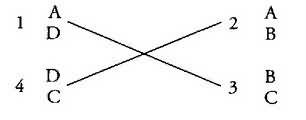
The notation A, B ... 1, 2 ... is not provided by Eriugena.
(11) I. 442A--B, II. 525A, II. 526C-527A, II. 527C. The fourfold schema is repeated later in Periphyseon but with no additions to the basic doctrine. Cf. III. 688C-689A, IV. 743B--C, V. 1019A--B.
From: Stephen Gersh, Structure, Sign, and Ontology from Johannes Scottus Eriugena to Anselm of Canterbury. A reply to Marenbon, in: Reading Plato, Tracing Plato. From Ancient Commentary to Medieval Reception, Aldershot, Ashgate 2005, Essay XIII.
